








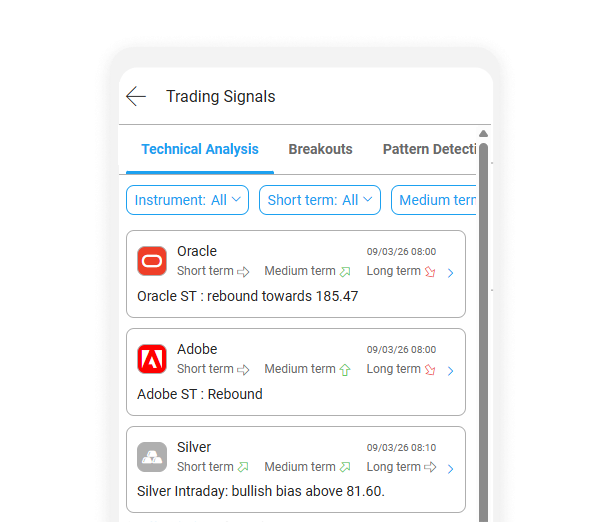
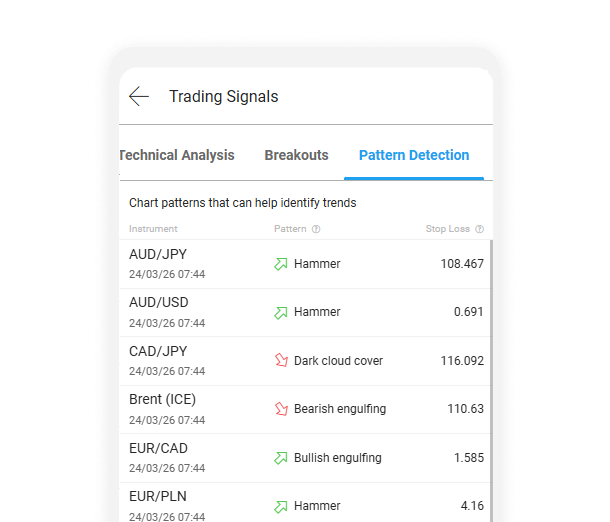
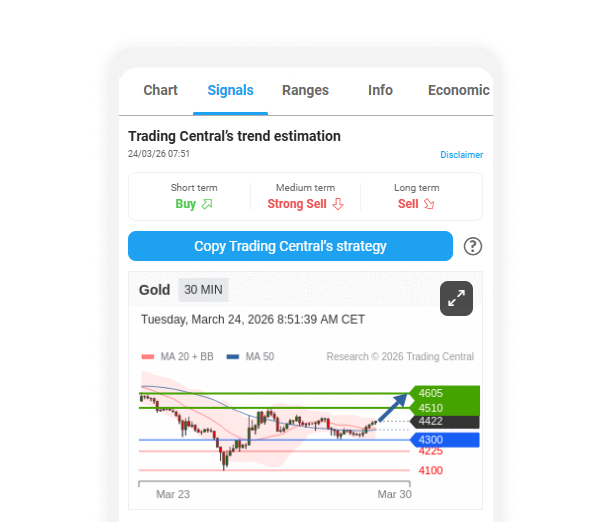
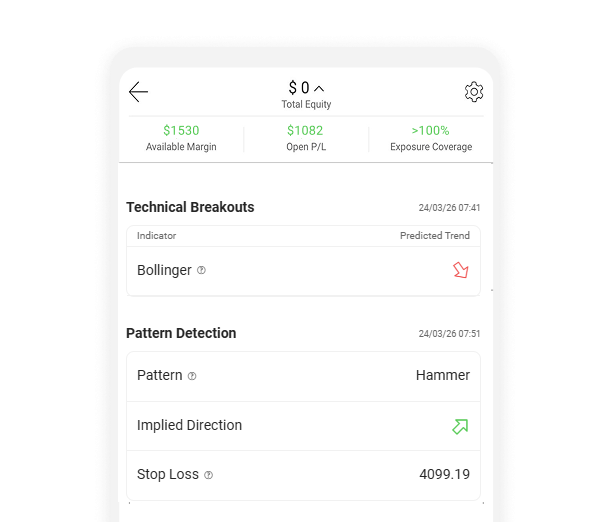
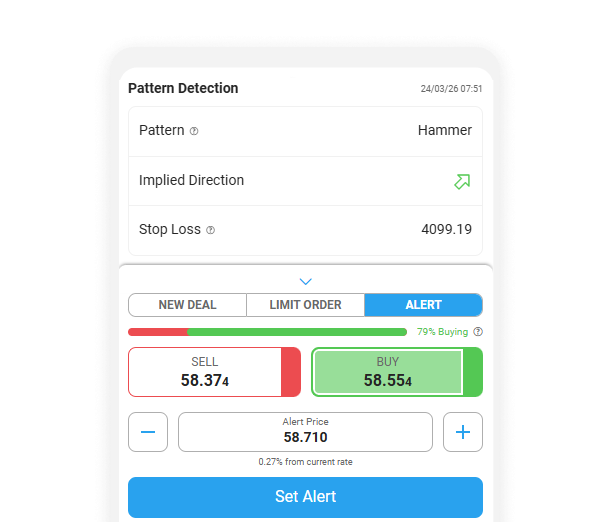


Instant alerts on price moves and trends, the moment a potential setup takes shape.
Powered by Trading Central.
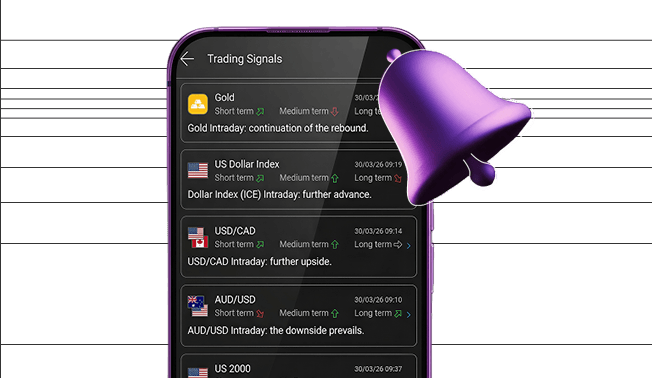


Trading signals have become a go-to tool for traders who want clearer decisions. Whether you’re placing your first trade or have years behind you, knowing what signals are and how to put them to work can bring more focus and discipline to your strategy.
Signals come from several places: technical indicators, hand-drawn chart analysis, automated systems and specialist signal providers.
With iFOREX, you choose the instruments, set your signal alerts and get push notifications straight to the app.
Types of signals
Short-term: built for intraday trading or scalping.
Medium-term: suited to swing trading over days to weeks.
Long-term: designed for position trading over weeks to months.
Before acting on any signal, find out how it was generated. Understanding the method helps you judge how reliable it is and whether it fits your strategy.
Lean on a single signal and you risk false alarms. Combining signals, or confirming them with other indicators, usually gives a more reliable read on market moves.
Never follow signals blindly. Always weigh the wider backdrop: economic news, market sentiment, volatility and the overall trend.
Before signals touch your live trading, test them on past data or a $5,000 virtual demo to see how they hold up.
Even the sharpest signals miss sometimes. So always apply sound risk management, from placing stop-loss orders to sizing every position in advance.

Up to 1:400 leverage to increase your deal sizes.

Global markets, long trading hours. You pick the moment.

Pro-grade charts plus AI-powered market insights.

Set stop-loss and take-profit levels upfront, and let your plan run the trade.
What our traders say

They’re indicators or suggestions that point to potential opportunities in the market, such as when to enter or exit a trade. Most are based on technical analysis, market trends or data-driven models.
Signals are built with technical indicators, manual chart analysis, automated algorithms or professional providers such as Trading Central. Each method draws on different data and its own approach to spotting potential market moves.
Yes. Signals can help newer traders see potential opportunities more easily, but use them alongside basic market knowledge and clear risk rules. For the right start, book your free one-to-one session with an Arabic-speaking coach.
No signal is ever guaranteed. Some offer genuinely useful insight, but conditions shift quickly and a signal won’t always play out as expected.
It’s not recommended. Combine signals with your own analysis, the market context and your risk plan to make better-informed calls. A signal is information, not investment advice.
Signals differ by timeframe (short, medium or long term) and by market: forex, shares, commodities or crypto. Each type suits a different trading style and strategy.
Try them on a demo account with $5,000 in virtual funds, or backtest them against historical data. You’ll see how they perform without putting real money on the line.
Check its track record and transparency, read user feedback, understand the pricing, and see whether it offers education that explains the logic behind its signals.
Yes. As your experience grows, you can develop your own signals from technical indicators, market research and patterns that fit your personal strategy.
Over-relying on signals, chasing too many at once, ignoring timeframes, trading on emotion and neglecting risk management.




















Your IP address tells us you are visiting from an EEA member state and therefore you should go to iFOREX Europe, the trading name of iCFD Ltd., a Cyprus investment firm, which operates under EU regulations and product intervention rules.
Please choose: